ISC2 Official Exam Prep
- 4.3
- Rating
- 50.00K
- Installs
- Free
- Price
 Analysis by App-foxy
Preparing for an ISC2 certification can feel scattered at first. You may have a study guide open on one screen, notes in another place, and no clear way to tell whether you are actually ready for exam-style questions. I found ISC2 Official Exam Prep useful because it turns that uncertainty into a repeatable practice routine. It is an education app from LearnZapp focused on CISSP, CCSP, and SSCP preparation, with question practice, flashcards, and a readiness score in one place.
My experience was strongest when I treated it as a daily training tool rather than a complete replacement for learning the subject. It is free to install, rated for Everyone, and has built a respectable audience with more than fifty thousand installs. The app currently sits at a 4.3 average from roughly a thousand ratings, which matches my impression: it is a practical and focused study companion, but its value depends heavily on how deliberately you use it.
From an Unclear Study Plan to a Repeatable Practice Routine
I use a clear routine to make certification practice manageable: choose the right track, work through a focused set, and review why each missed answer seemed tempting. That last step turns a score into a lesson I can carry into the next session. Once the routine is established, the next question is how to use the app efficiently when study time is short.
You May Also Like

 Blood Strike: 2.5 Anniversary
Blood Strike’s Loadouts Turn Every Drop Into a Tactical Gamble
A close look at Blood Strike’s custom loadouts: how fast access to signature weapons reshapes its battle royale rhythm, rewards preparation, and narrows the gap between fights.

 Pandora - Music & Podcasts
Pandora’s Music Is Easy to Start, but Harder to Recover
Pandora’s strength is its low-effort path from a seed to a station. Its weak spot is how much confidence it asks you to place in connection, setup, and quiet recovery.

 8 Ball Pool
 Is Built on Rivalries, Rematches, and Routine
A close look at the rivalries, rematches, shared routines, and unanswered safety questions that turn a quick pool match into a persistent mobile community.

 Samsung Music
’s Quiet Strength Is Playing What You Already Own
Its reach comes less from spectacle than from dependable access to a personal library. That simplicity is both the app’s strongest retention engine and its ceiling.

 AccuWeather: Weather Radar
AccuWeather Review: A Quick, Clear Forecast for Everyday Decisions
For everyday plans, the best forecast is the one you can understand quickly. AccuWeather makes rain timing, radar, and local conditions easy to act on, with a few trade-offs.

 Hill Climb Racing
Why Hill Climb Racing Still Turns Crashes Into One More Run
A tiny car, a bumpy hill and one more upgrade: Hill Climb Racing keeps resurfacing because its simple chaos makes every near-miss feel personal.
More From Our News Desk
View All News


Starting with the right expectation
The first important decision is choosing what you want from the app. If you already understand the broad security concepts and need structured exam practice, this tool makes immediate sense. If you are starting from zero and expect an app to teach every topic from the ground up, I would be more cautious. Practice questions can expose gaps, but they do not automatically build the deeper understanding needed to explain why an answer is correct.
I would begin by selecting the certification track that matches the exam I am pursuing. That choice matters because CISSP, CCSP, and SSCP overlap in security vocabulary while emphasizing different responsibilities and levels of judgment. Mixing them casually could make a study session feel productive without necessarily moving me toward the right exam outcome.
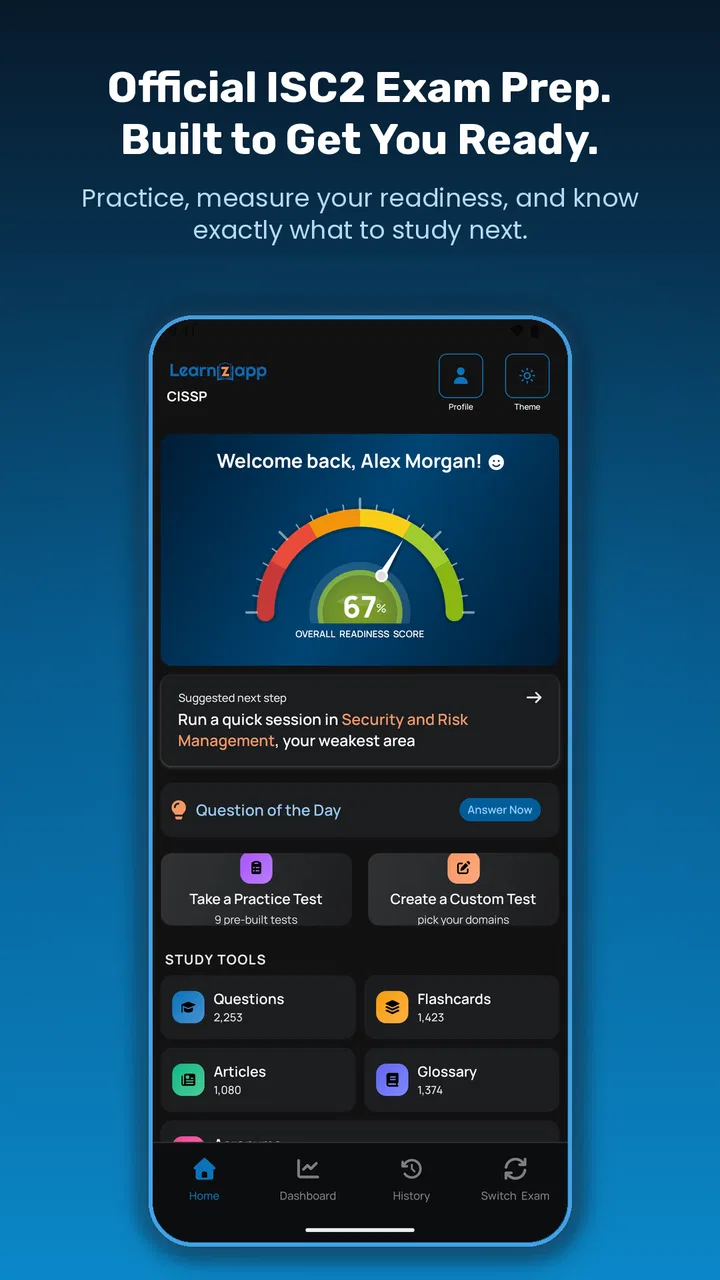
The app’s central promise is its large practice library, with more than five thousand questions, alongside flashcards and a readiness score. Those elements serve different purposes. Questions test decision-making, flashcards help with quick recall, and the readiness indicator gives a broad progress signal. The useful workflow is to move between all three instead of spending every session answering questions at random.
My first pass through the question bank
I would start with a diagnostic session rather than immediately trying to achieve a high score. The goal is to discover whether mistakes come from missing knowledge, confusing similar terms, rushing through wording, or choosing an answer that sounds technically true but is not the best response to the scenario.
That distinction is especially important for professional certification questions. A wrong answer does not always mean I know nothing about the topic. Sometimes I recognize the concept but miss the priority, the role involved, or the order in which an action should happen. I found it more useful to record the reason for each mistake than to focus only on the percentage at the end.
A practical routine is to answer a small set of questions, review every explanation available in the app, and then create a short list of weak areas in my own notes. I would not copy every question into a notebook. Instead, I would write down the rule or decision pattern that caused the error. This keeps the handoff from app practice to deeper study manageable.
Using flashcards without turning study into guessing
Flashcards are most helpful after I have encountered a concept in context. Used too early, they can encourage recognition without understanding: I see a familiar term and feel that I know it, even though I could not apply it to a workplace situation. Used after question practice, they become a quick way to reinforce definitions, distinctions, and short lists.
I would use flashcards during small gaps in the day, such as a commute without driving, a lunch break, or the final few minutes before ending a study session. The key is to pause before revealing an answer and explain the idea in my own words. If I can only recognize the wording on the card, I would mark that concept for a longer review later.
One useful trade-off is speed versus depth. Flashcards let me cover more material quickly, while questions demand more attention and reveal whether I can reason under pressure. The app works best when flashcards maintain familiarity between longer sessions, not when they replace scenario-based practice.
Turning the readiness score into a decision tool
The readiness score is appealing because it gives a simple answer to an uncomfortable question: am I getting closer? I would treat it as a trend rather than a guarantee. A rising score can show that my practice is becoming more consistent, but it cannot by itself prove that I understand every domain or that I will perform equally well in a different question set.
To make the score useful, I would check it after several comparable study sessions instead of reacting to every change. I would also compare it with the kinds of mistakes I am making. A stable score with fewer careless errors may represent better progress than a sudden jump caused by repeating familiar material.
This is one of the app’s more valuable workflow ideas: the result is not just a number to admire. It should determine what I do next. If the score improves but one topic repeatedly causes trouble, I would leave the app temporarily, consult a fuller study resource, and return for targeted practice. If the score is low because I am rushing, I would change my session method before buying more material.
Building a realistic daily session
For a normal weekday, I would divide study into three stages. I would begin with a short flashcard review to reactivate terminology, continue with a focused question set, and finish by reviewing mistakes rather than immediately starting another set. This creates a clear path from memory to application to correction.
For example, imagine I have a demanding workday and only a limited evening window. I could use flashcards while waiting for dinner, complete a focused practice session later, and write three notes about errors before going to bed. The next day, I would revisit those notes before answering new questions. That small handoff prevents the common problem of completing hundreds of questions while learning very little from them.
On a weekend, I would use a longer session to test endurance and concentration, then reserve time to investigate unfamiliar concepts outside the app. The application is convenient because the practice material and progress feedback stay together, but convenience can also tempt me to remain inside the question bank when I actually need a textbook, course, lab, or professional discussion.
Where the handoffs matter most
The first handoff is from a missed question to a useful explanation. I would ask myself three things: what did I choose, why did it seem attractive, and what clue should have changed my decision? This approach is more valuable than simply memorizing the correct option, because exam questions often present a new situation around a familiar principle.
The second handoff is from the app to external study material. When a question reveals a genuine knowledge gap, I would pause the practice loop and study that topic in greater depth. The app can tell me where friction appears; a broader resource is usually better for building a detailed mental model. Returning afterward lets me test whether the explanation has actually stuck.
The third handoff is from individual practice to professional context. Security concepts make more sense when connected to responsibilities, risk, governance, architecture, and operational consequences. I would try to explain a difficult answer aloud as if I were discussing it with a colleague. If I cannot explain the reasoning without repeating the answer choices, I am not ready to rely on that topic.
These handoffs are also where the app’s limitations become visible. A question bank can organize repetition very well, but it cannot know the exact background, work experience, or learning style I bring to the subject. I still have to supply judgment and decide whether a weak result reflects a missing definition, poor reading, or a larger conceptual problem.
What the app does better than scattered alternatives
Compared with studying from a static book alone, this app makes active recall easier and gives me a quicker way to see whether I can apply an idea. Compared with random online quizzes, its focus on CISSP, CCSP, and SSCP keeps the practice closer to a defined certification path. Compared with ordinary note-taking apps, it provides a study loop instead of asking me to design every review activity myself.
Its advantage is not that it eliminates other resources. Its advantage is reducing the friction between deciding to study and actually answering relevant questions. That matters on busy days, when opening a book, choosing a chapter, writing questions, and tracking mistakes can become enough resistance to skip the session entirely.
On the other hand, a full course or well-written reference may be better for a learner who needs guided teaching, examples, or a systematic explanation of difficult domains. Someone who learns best through labs and hands-on exercises may also find a question-centered app too abstract. I would use this app as the practice layer in a broader plan, not assume it is the entire plan.
Free access and the point where costs enter
The app is free to download, which makes it easy to test the workflow before committing to it. That is useful because the right question is not simply whether the app contains practice material; it is whether its presentation, explanations, and pacing fit the way I study.
There are in-app purchases ranging from $4.99 to $139.99 per item. I would pay attention to what is available during the free experience and decide only after identifying a specific limitation in my current routine. Buying access before establishing a habit can turn a promising tool into an expensive collection of unused study material.
For me, the sensible order is to complete several sessions, review the quality of the explanations, and see whether the readiness feedback changes my behavior. If the app becomes the place where I consistently practice and diagnose weaknesses, an upgrade may be easier to justify. If I only open it occasionally, purchasing more content is unlikely to solve the real problem.
Practical friction during longer preparation
The biggest friction is psychological rather than technical: practice scores can feel like a verdict. I had to remind myself that a poor session is information, not a final judgment. A question bank is most useful when it exposes uncomfortable gaps early enough to address them.
Another limitation is the risk of familiarity. Repeated exposure to similar questions can make answers feel obvious, even if I have not developed flexible understanding. I would counter that by changing the order of review, explaining answers without looking at the choices, and checking difficult subjects in another source before returning to the app.
The app also requires discipline around pacing. It is easy to chase a readiness score or complete a large number of questions while skipping the review stage. I would rather finish a smaller session with clear notes than rush through a long one and remember only that I was busy studying.
Who should use it, and who should skip it
I would recommend ISC2 Official Exam Prep to a learner who already has a study foundation and wants a portable way to practice CISSP, CCSP, or SSCP-style material. It is particularly suitable for people who need structure during short sessions, want flashcards close to their question practice, and benefit from a visible readiness signal.
It is also a good fit for a working security professional who can connect questions to real responsibilities but needs a consistent review habit. The app’s compact format makes it easier to turn spare moments into deliberate practice, provided those moments are followed by proper review.
I would be less likely to recommend it as the only resource for a complete beginner, someone seeking hands-on technical training, or a learner who needs an instructor to explain every concept from first principles. In those cases, a course, reference book, study group, or lab environment may deserve priority, with this app added later for testing and reinforcement.
Version, platform fit, and everyday accessibility
The current version is 32.0.0, and it supports devices running Android 7.0 or later. That makes it accessible to people who are not using the newest phone, which is helpful for a study tool intended to be available during ordinary daily routines. I would still keep my study notes somewhere separate so that my learning record is not dependent on one application.
Because the content rating is Everyone, the app is presented as a general education resource rather than entertainment aimed at a restricted audience. Its tone and purpose are clearly professional: I open it with a particular certification goal in mind, not to browse casually.
The result after following the workflow
Used consistently, the app gives me a clearer answer than a vague feeling of having studied. I can identify recurring weaknesses, revisit terms with flashcards, test decisions through questions, and use the readiness score as one progress signal. The outcome is not instant mastery, but a more organized path from uncertainty to measurable practice.
The strongest result comes when I treat every missed answer as a handoff to the next action. A terminology problem leads to flashcards. A reasoning problem leads to explanation and comparison. A broad conceptual gap leads to an external study resource. Once that chain becomes habitual, the app stops being just a quiz collection and becomes the center of a practical review loop.
My final recommendation
ISC2 Official Exam Prep is a focused, useful education app for certification candidates who want practice to be easier to start and easier to track. LearnZapp has brought questions, flashcards, and readiness feedback into one workflow, and the free entry point makes it reasonable to test before spending money.
I would not use it as my only teacher, and I would not confuse a strong readiness score with guaranteed exam success. Its real strength is helping me practice deliberately, notice patterns in my mistakes, and return to difficult material with a plan. If that is the missing piece in my preparation, I would recommend giving it a serious trial. If I need deep instruction or hands-on security work first, I would choose those resources before making this app the main part of my study plan.
FAQs for ISC2 Official Exam Prep
01What is ISC2 Official Exam Prep, and which certifications does it support?
ISC2 Official Exam Prep is a study and revision resource designed to help candidates prepare for ISC2 certification exams. Its content may include practice questions, learning materials, progress tracking, and exam-focused guidance. The exact certifications supported can vary by version and subscription, so candidates should check the app listing and in-app catalog to confirm whether it covers exams such as Certified in Cybersecurity, CISSP, CCSP, or another ISC2 credential.
02Is ISC2 Official Exam Prep enough to pass an ISC2 certification exam?
The app can be a useful part of a preparation plan, especially for reviewing concepts and testing your knowledge with practice questions, but it should not necessarily be your only study resource. ISC2 exams assess broad domains and practical understanding, so combining the app with the official exam outline, ISC2 publications, professional experience, and additional practice is recommended. Treat the app as a supplement rather than a guaranteed shortcut to certification.
03Does the app include realistic practice questions and explanations?
ISC2 Official Exam Prep is intended to provide exam-oriented practice, which can help you become familiar with question wording, timing, and common cybersecurity topics. Before downloading, review the current store description to confirm whether explanations, answer rationales, mock exams, and domain-based quizzes are included in your version. Explanations are especially important because understanding why an answer is correct is more valuable than simply memorizing choices.
04Can I use ISC2 Official Exam Prep offline or on multiple devices?
Offline access and multi-device support depend on the app’s current technical design, account system, and subscription terms. Some study apps allow selected lessons or question sets to be downloaded, while others require an internet connection for synchronization, updates, or account verification. After installation, check the settings and account information to see which materials work offline and whether your progress can be restored across Android, iPhone, or other supported devices.
05Is ISC2 Official Exam Prep free to download, and are there in-app purchases?
The app may be free to install while reserving some study content, question banks, advanced statistics, or full practice exams for a paid plan. Pricing, trial availability, and renewal conditions can change by country, platform, and certification package. Before starting a trial or subscription, carefully read the purchase screen, billing interval, cancellation rules, and included features so you understand exactly what access you are receiving.
Pros
- Officially aligned with ISC2 certification exam objectives.
- Practice questions help identify knowledge gaps before exam day.
- Useful for structured study sessions on mobile devices.
- Supports preparation for several respected cybersecurity certifications.
- Professional terminology reflects real-world security concepts.
Cons
- Some content may require an active subscription or paid access.
- Question difficulty may not fully match the real certification exam.
- Limited value for learners without basic cybersecurity knowledge.
- Mobile studying can be less comfortable for reviewing long explanations.
- It should complement
- not replace
- hands-on labs and reference materials.

ISC2 Official Exam Prep
Gallery